When it comes to traditional Indian jewellery, the Polki vs Kundan debate is one that has captivated brides, collectors and jewellery lovers for generations. Both styles carry a rich royal heritage, gracing the necks and wrists of Maharanis at weddings and festivals for centuries. Furthermore, both offer a beauty that is truly unmatched – however, they are remarkably different in their origins, appearance and value.
However, if you have ever found yourself wondering why one glows softly while the other dazzles brilliantly – or why the price points differ so significantly – this Polki vs Kundan guide is here to help. At Stonira, we believe that understanding the soul of your jewellery makes wearing it even more meaningful.
What is Polki? Understanding the Raw Diamond
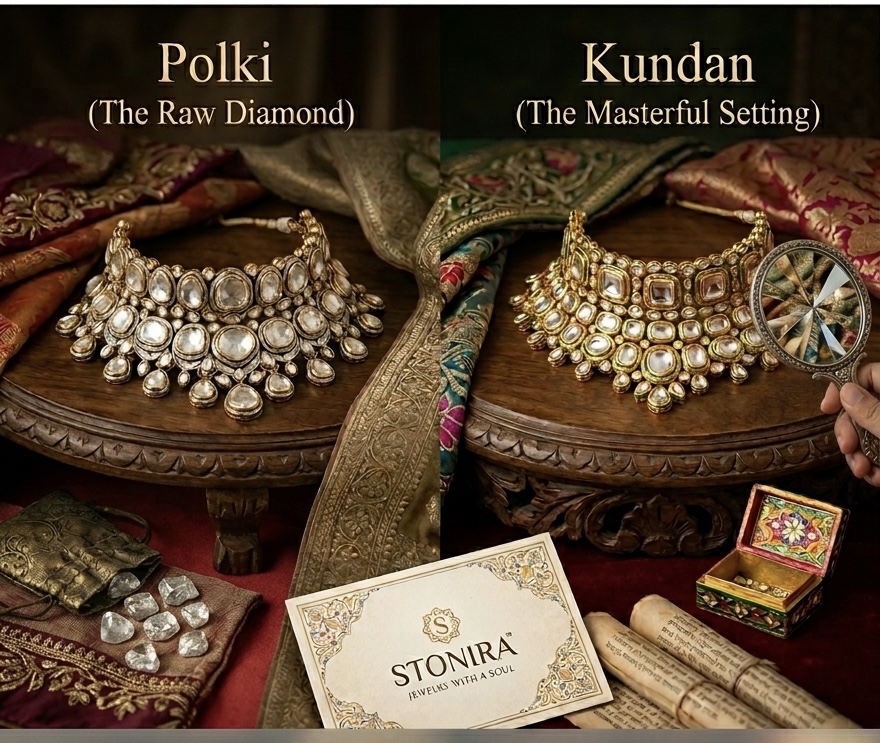
Polki refers to raw, uncut diamonds in their most natural form. Originating from the Mughal era, this style celebrates the stone exactly as nature intended – uncut, unfaceted and entirely unique.
Because Polki diamonds are not faceted like modern diamonds, they do not sparkle in a sharp or brilliant way. Instead, they offer something far more special – a soft, deep and vintage glow that feels as though it carries centuries of history within it.
The Key Qualities of Polki Jewellery
The Look:
Earthy, antique and incredibly unique. Furthermore, because no two natural diamonds are exactly the same, no two Polki pieces are ever truly identical. Each one is a wearable work of art.
The Value:
Since Polki uses natural diamonds, it is considered a high-value heirloom investment. As a result, Polki pieces are often passed down through generations, growing in both sentimental and monetary value over time.
Best For:
The bride or collector who is drawn to authentic old-world beauty. If you love the idea of wearing something that feels as though it was plucked from a royal treasury, Polki is therefore the style for you.
To learn more about the history of Mughal jewellery, the Victoria and Albert Museum has a fascinating overview here. Link to: https://www.vam.ac.uk
What is Kundan? Understanding the Masterful Setting
Many people assume that Kundan refers to a particular type of stone. However, Kundan actually refers to a setting technique – and it is one of the most refined and skilful crafts in all of Indian jewellery making.
The Kundan technique involves using 24 karat highly refined pure gold foil to mount stones – typically glass stones or synthetic crystals – into an intricately crafted frame. Additionally, the reverse side of Kundan pieces is often adorned with beautiful Meenakari enamel work, making them as stunning from the back as they are from the front.
The Key Qualities of Kundan Jewellery
The Look:
Polished, vibrant and brilliantly eye-catching. Kundan jewellery has a brightness and clarity that makes it the perfect choice for festive occasions where you want to truly shine.
The Value:
More accessible than Polki, Kundan is therefore perfect for those who want high-fashion statement pieces without compromising on luxury or craftsmanship. Furthermore, the intricate setting technique means each piece still represents hours of skilled artisanal work.
Best For:
Festive celebrations, sangeets and bridesmaids who want maximum impact and shine. Additionally, because Kundan often features colourful enamel work, it is perfect for coordinating your jewellery with specific outfit colours.
Polki vs Kundan – How to Tell the Difference at a Glance
| Feature |
Polki |
Kundan |
| Stone |
Natural uncut diamonds |
Glass stones or synthetic crystals |
| Glow |
Soft, vintage and deep |
Bright, clear and brilliant |
| Backing |
Silver or gold toned |
Often decorated with Meenakari enamel |
| Value |
High – heirloom quality |
Accessible – great for festive wear |
| Best For |
Brides and collectors |
Festive occasions and celebrations |
| Origin |
Mughal era |
Traditional Rajasthani craft |
Polki vs Kundan – Which One Should You Choose?
This is perhaps the most important question in our Polki vs Kundan guide – and the answer is beautifully personal.
Choose Polki if…
You are a lover of history, raw natural beauty and timeless elegance. Furthermore, if you want a piece that feels as though it carries centuries of royal heritage within it – and will only grow in sentimental value over time – Polki is consequently the perfect choice for you.
Polki is therefore ideal for:
- ✨ Brides wanting an authentic heritage bridal look
- ✨ Collectors investing in heirloom quality jewellery
- ✨ Those who love the beauty of natural, uncut stones
- ✨ Women who prefer a soft, warm glow over sharp sparkle
Choose Kundan if…
You love vibrant colours, high-wattage shine and the ability to coordinate your jewellery with your outfit. Additionally, if you want a regal and luxurious look for a festive event without the investment of natural diamonds, Kundan is therefore the ideal choice.
Kundan is consequently perfect for:
- ✨ Festive occasions, sangeets and celebrations
- ✨ Bridesmaids wanting to complement the bridal look
- ✨ Those who love colourful Meenakari enamel work
- ✨ Women who want maximum shine and impact
The Best of Both Worlds – Stonira’s Polki Kundan Collection
At Stonira, we have always believed that you should never have to choose between heritage and modernity. Furthermore, we believe that the most beautiful jewellery is the kind that tells a story.
That is why many of our signature designs combine both techniques – using Polki-cut stones set within a traditional Kundan-style setting. As a result, you get the soft vintage glow of Polki alongside the brilliant craftsmanship of Kundan in a single, breathtaking piece.
Our Polki & Kundan Jhumka with Green Enamel is a perfect example of this philosophy. Additionally, these pieces are designed for the modern woman who carries her heritage with grace – from festive gatherings to candlelit evenings.
We hope this Polki vs Kundan guide has helped you understand these two extraordinary styles and brought you one step closer to finding your perfect piece.